Performance of Different Cotton Genotypes under Different Infestation Levels of Whitefly Populations
Keywords:
Cotton, Whitefly, Leaf Curl Virus, Bemisia Tabaci, Disease Incidence, YieldAbstract
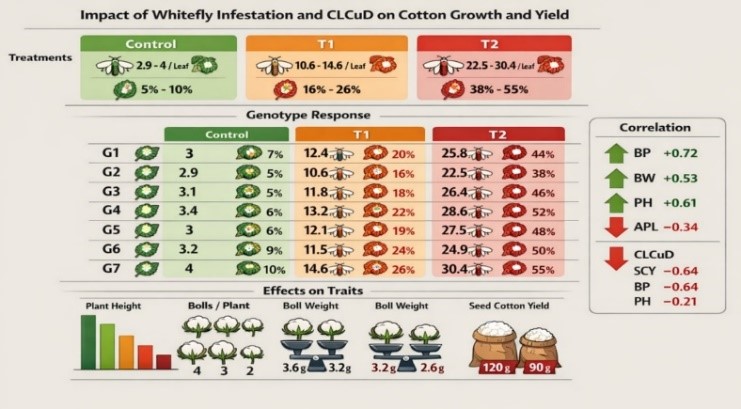
Cotton (Gossypium hirsutum L.) production is severely limited by biotic stresses such as whitefly (Bemisia tabaci) infestation and CLCuD. Seven cotton genotypes were evaluated under three levels of stress (Control, T1, and T2) in a factorial completely randomized design with three replications in April 2025, sown at Plant Pathology Research Institute, Ayub Agricultural Research Institute, Faisalabad, to study pests and disease dynamics, growth and yield components, as well as the relationship among important agronomic parameters. Adult whitefly densities and disease indices increased gradually from Control to T2 , while G6 was always the most susceptible and G3 the least. Growth indices followed similar trends, confirming an increase in pest and disease pressure severely compromising plant health. Similarly, plant height, bolls per plant, boll weight, and seed cotton yield decreased in whitefly treatments, with more reduction under T2. Correlation studies indicated strong negative relationships of adult whitefly populations and CLCuD incidence with growth characters, whereas bolls per plant, boll weight, and plant height were positively correlated with seed cotton yield. Seed index showed negative correlations with almost all the yield components and a positive correlation with disease incidence, revealing compensatory allocation under stress. ANOVA revealed that the causes of variation in yield-related traits were up to 80 % attributed to genetic differences, and disease expression was more affected by treatment factors. This indicated that the distribution of plant height was equally due to genetic and treatment (phenotypic plasticity) factors. These findings in general indicate that whitefly infestation, along with CLCuD have significant deterring effect on the growth and yield of cotton, as well as genotype variation for susceptibility and yield potential. These findings provide a practical foundation for cotton breeding programs by identifying stable, stress-tolerant genotypes and key selection traits that can be exploited to develop high-yielding cultivars with enhanced resistance to whitefly and CLCuD under biotic stress environments.