Comparative Evaluation of Chemical Resistance Inducers (Methyl Jasmonate, Salicylic Acid, Chitosan, Sodium Nitroprusside, and Calcium Carbide) for Managing Early Blight (Alternaria solani) in Tomato
Keywords:
Tomato, Alternaria Solani, Pythium spp, Resistance Inducers, Early Blight, Induced ResistanceAbstract
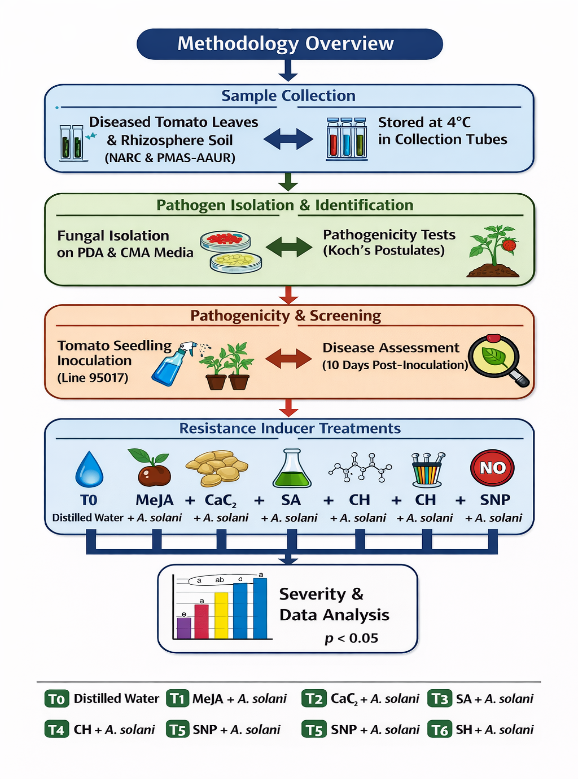
The present study was conducted to evaluate the efficacy of different resistance-inducing agents against fungal pathogens associated with diseased tomato plants collected from the National Agricultural Research Centre and PMAS-Arid Agriculture University, Rawalpindi. Two pathogens, Alternaria solani (causing early blight) and Pythium spp. (causing damping-off), were identified. Early blight incidence was recorded at 44% and 22% at the respective locations, while damping-off was observed only at PMAS-AAUR. Pathogenicity of A. solani was confirmed through Koch’s postulates on tomato cultivar Reograndi and line-95017, with the latter exhibiting higher susceptibility and being selected for subsequent experiments. Resistance inducers, including methyl jasmonate (MeJA), salicylic acid (SA), chitosan (CH), sodium nitroprusside (SNP), and calcium carbide (CaC₂; ethylene donor), were applied before pathogen inoculation. Significant differences (p ≤ 0.05) were observed among treatments for disease severity assessed 10 days after inoculation. MeJA treatment resulted in the lowest disease severity (14.15%), representing a ~68.5% reduction compared to the positive control (44.98%). However, the reduction achieved by MeJA was statistically at par with CaC₂ (16.58%) and CH (18.21%), indicating non-significant differences among these treatments. SNP also significantly reduced disease severity (23.80%), whereas SA showed comparatively lower efficacy (30.13%), remaining significantly higher than MeJA-treated plants but lower than the positive control. The results indicate that resistance inducers associated with jasmonic acid and ethylene signaling pathways were more effective against the necrotrophic pathogen A. solani, while SA-mediated resistance was comparatively less effective. The moderate efficacy of CH and SNP suggests their role in activating induced systemic resistance and basal defense mechanisms. Overall, the study demonstrates that resistance inducers can significantly reduce early blight severity and may be integrated into sustainable disease management strategies, provided that inducer selection aligns with pathogen biology.