Evaluating the Efficacy of Different Chemical Treatments on Weed Density, Biomass Accumulation, and Physiological Traits in Pearl Millet
Keywords:
Herbicide, Weeds, Weed Density, Pearl Millets, Chemical TreatmentAbstract
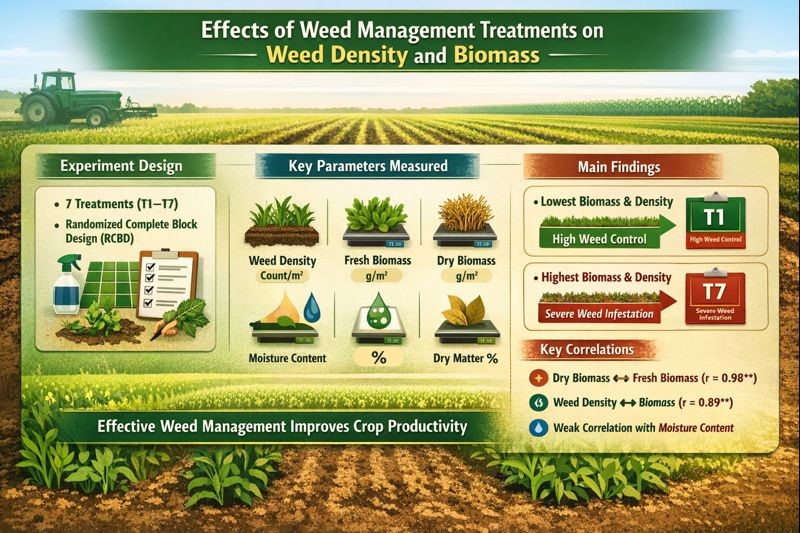
Weeds are one of the major limitations to the productivity of crops in that they compete with vital resources like light, nutrients, water, and space. The current research aimed to determine the efficacy of various weed management treatments on the weed density, biomass production, weed moisture content and species composition. The experiment was planned in a randomized complete block design (RCBD) involving seven treatments (T1–T7) and three replications. The data were systematically measured on weed flora, weed density (2.54–33.79 plants m⁻²), fresh biomass (14.04–241.29 g m⁻²), dry biomass (7.00–149.21 g m⁻²), moisture content (41.99–241.29%), and dry-matter percentage (35.49–57.00%). The ANOVA showed that the effect of treatments on all the parameters measured was highly significant (p < 0.01), especially on fresh and dry biomass, indicating that the treatments strongly suppressed weeds. T1 had the lowest weed density (2.54 plants m⁻²), fresh biomass (14.04 g m⁻²), and dry biomass (7.00 g m⁻²), while T7 had the highest values (33.79 plants m⁻², 241.29 g m⁻², and 149.21 g m⁻², respectively), indicating weed suppression of more than 90% under T1 compared to T7. Correlation analysis showed strong positive relationships among weed density, fresh biomass, and dry biomass (r = 0.86–0.98, p < 0.01). This confirms that higher weed populations lead to increased biomass. The content of moisture had weak and non-significant correlations (r = –0.13 to –0.03) with other characteristics, indicating its weak influence on weed growth dynamics. Weed density data showed that T1 recorded the lowest populations of broad-leaves (5.00 plants m⁻²), sedges (0.67 plants m⁻²), khabal (2.00 plants m⁻²), and madhana (0.00 plants m⁻²) at 15 DAS, whereas T7 exhibited the highest densities for broad-leaves (92.00 plants m⁻²) and sedges (28.67 plants m⁻²), indicating severe infestation under untreated conditions. At 30 DAS, T4 recorded the lowest densities of broad-leaves and sedges (3.33 plants m⁻² each), and T3 had the lowest khabal density (0.67 plants m⁻²), while T7 again recorded the maximum values for most weed groups, confirming its lowest weed suppression efficiency. In general, the findings indicated the significance of proper weed-management methods to minimize weed pressure and improve crop production systems. The results are useful in the choice of suitable weed control measures in similar agro-ecological settings. The graphical abstract has been drawn in Figure 1.