Screening of Maize (Zea mays L.) Genotypes for Resistance Against Fall Armyworm (Spodoptera Frugiperda) Under Field Conditions
Keywords:
Fall Army Worm, Maize, Yield, Cob, Infestation, DiseaseAbstract
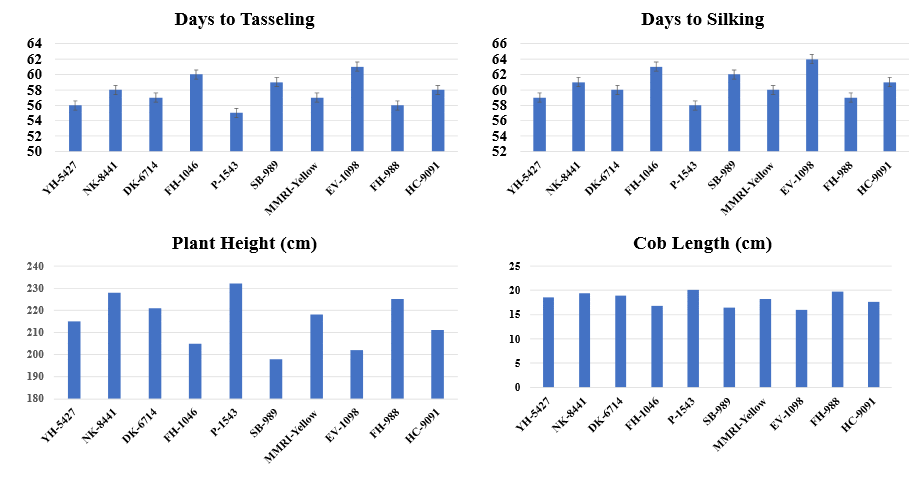
Fall armyworm (Spodoptera frugiperda) has emerged as one of the most destructive invasive insect pests threatening global maize production, particularly under changing climatic conditions. The present study was conducted to evaluate the resistance response of ten maize genotypes against fall armyworm under natural field infestation conditions. The experiment was laid out in a Randomized Complete Block Design with three replications. Data were recorded for phenological traits, yield-related parameters, and fall armyworm damage characteristics, including infestation percentage, leaf damage score, and ear damage score. Significant variation was observed among maize genotypes for all studied traits. Days to tasseling ranged from 55 to 61 days, while days to silking varied from 58 to 64 days. PH ranged from 198 to 232 cm and CL varied between 15.9 and 20.1 cm. Significant differences were also observed for yield-related traits, where grain yield ranged from 4860 to 7825 kg ha⁻¹. Genotype G5 produced the highest grain yield (7825 kg ha⁻¹), maximum cob length (20.1 cm), highest number of grains per cob (536), and maximum 100-grain weight (34.6 g). In contrast, G8 produced the lowest grain yield (4860 kg ha⁻¹) with poor yield-related performance. Fall armyworm infestation percentage ranged from 21.2 to 62.5%, while leaf damage score and ear damage score varied from 2.3–7.4 and 2.1–6.8, respectively. Genotype G5 exhibited the lowest infestation percentage (21.2%), minimum leaf damage score (2.3), and lowest ear damage score (2.1), indicating strong resistance/tolerance against fall armyworm. Conversely, G8 was identified as the most susceptible genotype with the highest infestation percentage (62.5%), leaf damage score (7.4), and ear damage score (6.8). Correlation analysis revealed strong negative associations of fall armyworm infestation and ear damage with grain yield, while yield showed positive associations with cob length, number of grains per cob, and 100-grain weight.